Future-Proofing Your Retail Business
In the current US retail landscape, small and mid-sized businesses (SMBs) face a unique convergence of pressures. From fluctuating consumer confidence and inflationary headwinds to the persistent challenge of labor shortages, the margin for error is thinner than ever. Yet, the modern American shopper remains demanding—expecting a seamless, "Amazon-like" experience whether they are browsing on Instagram, buying online, or walking into your brick-and-mortar store.
For retail leadership, the decision to upgrade a Customer Relationship Management (CRM) platform is not merely an IT purchase; it is a strategic investment in Customer Lifetime Value (CLV). While many point solutions exist, Salesforce offers a distinct value proposition for the retail SMB that goes beyond simple contact management. Here is why consolidating your operations on the Salesforce ecosystem is a prudent move for driving retention and revenue.
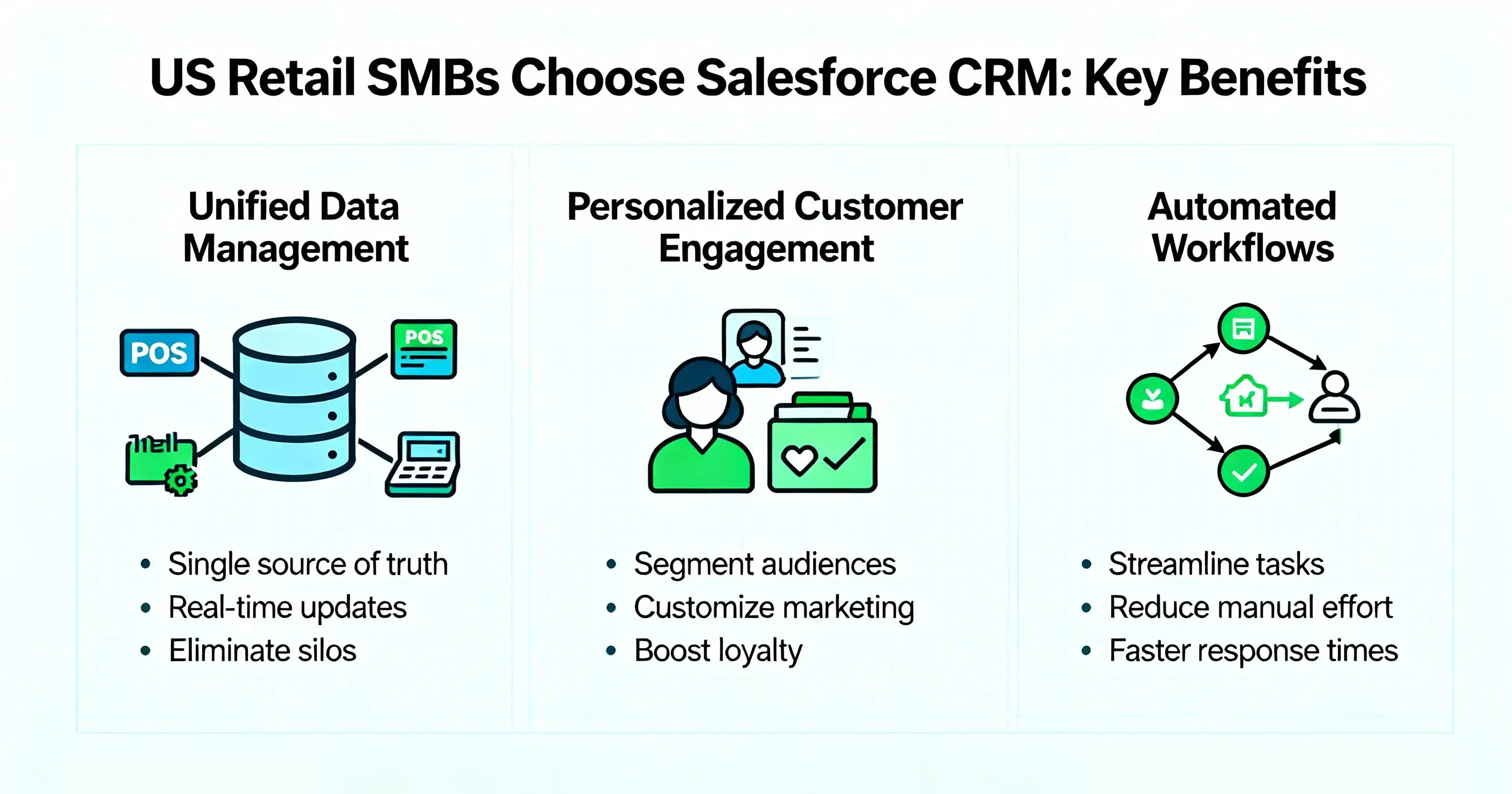
1. Solving the "Disconnected Data" Dilemma
The most significant barrier to growth for retail SMBs is often "tech debt"—a patchwork of disconnected systems where your Point of Sale (POS) does not speak to your e-commerce site, and your marketing email tools are unaware of in-store returns.
Salesforce solves this through Unified Commerce. By establishing a "Single Source of Truth" (Customer 360), you gain a holistic view of your patron. When a customer calls your support line, your agent immediately sees that they purchased a high-margin item last week and abandoned a cart yesterday. This visibility allows you to transition from transactional interactions to relational ones, directly impacting your Average Order Value (AOV).
2. Personalization at Scale: The New Standard of Clienteling
In an era where customer acquisition costs (CAC) are rising, retention is the new growth. Generic "batch and blast" email campaigns no longer suffice.
Salesforce leverages Data Cloud and Einstein AI to democratize enterprise-level personalization for SMBs. You can automate sophisticated "clienteling" journeys that were previously manual and time-consuming. For instance:
Predictive Sorting: Automatically promoting products on your digital storefront that a specific visitor is most likely to buy.
Automated Retention: Triggering a personalized SMS or email when a loyal customer hasn’t visited in 90 days, potentially offering a curated incentive based on their purchase history.
This capability allows a lean marketing team to execute campaigns with the sophistication of a Tier-1 retailer.
3. Operational Efficiency via AI and Automation
With labor costs rising across the US, doing more with less is an operational necessity. Salesforce’s recent innovations in Agentforce and automation allow you to offload repetitive tasks.
Service Efficiency: Chatbots can handle Level 1 inquiries (e.g., "Where is my order?" or "What is your return policy?") 24/7 without human intervention. This frees your associates to handle high-touch, complex issues that require empathy and problem-solving.
Inventory Visibility: By integrating order management, you can offer Buy Online, Pickup In-Store (BOPIS) or Ship-from-Store capabilities with confidence, preventing the dreaded "out of stock" notification after a purchase is made.
4. Scalability and the Ecosystem
A critical risk for SMBs is outgrowing their tech stack. A platform that works for $5M in revenue often breaks at $20M. Salesforce is built to scale. You might start with Salesforce Starter or Growth Edition for rapid implementation, but the infrastructure supports you all the way to enterprise status.
Furthermore, the AppExchange ecosystem allows you to plug in niche retail tools—from specific inventory management ERPs to loyalty program apps—without expensive custom coding. This agility ensures you can pivot your strategy as market trends shift without replatforming.
Conclusion: The ROI of Trust
Ultimately, Salesforce offers more than software; it offers a pathway to digital maturity. In a market where trust and experience dictate loyalty, having a robust, secure, and scalable CRM is your competitive moat. By unifying your data, personalizing your outreach, and automating your operations, you position your brand not just to survive the current economic cycle, but to thrive in the next.