How Salesforce AI and Data Cloud Will Shape Your 2026 Go-To-Market Strategy
As organisations enter 2026, the competitive landscape is shifting decisively toward those who can harness artificial intelligence and unified data as core revenue levers. AI adoption has surged 282% since 2024, with full implementations growing from 11% to 42% of enterprises, and CIOs are now dedicating 30% of budgets to AI-driven initiatives.
Meanwhile, Salesforce Data Cloud has crossed the $900 million annual recurring revenue milestone, reflecting strong market demand for unified, real-time customer intelligence. For sales leaders, revenue operators, and account teams, the message is clear: AI and data are no longer optional investments—they are the foundation of 2026 go-to-market success.
1. AI is Moving from Pilots to the Core of Sales and Service Operations
The Shift Toward Autonomous Agents
Throughout 2025, generative AI evolved from experimentation to embedded, cross-functional execution. In 2026, this acceleration continues with autonomous AI agents now performing mission-critical tasks across Sales Cloud and Service Cloud. These agents are not experimental chatbots; they are intelligent digital team members that triage cases, write outreach, analyse opportunities, and recommend next steps in real time.
What this means for your business:
Sales representatives now work with AI analysts that summarise calls, highlight deal risks, and propose personalised close strategies—allowing reps to spend more time in customer conversations and less time on administrative work
Service teams leverage AI to handle higher ticket volumes without sacrificing customer satisfaction, with agents recommending knowledge articles, escalating intelligently, and resolving routine inquiries autonomously
Revenue operations leaders gain visibility into forecast accuracy and pipeline health through AI-driven anomaly detection and predictive scoring, reducing the time spent on manual reconciliation
The Gartner forecast is striking: 40% of enterprise applications will include task-specific AI agents by the end of 2026, up from less than 5% today. This transition is not incremental—it is a fundamental reimagining of how sales and service teams work.
Agentic Momentum Across Industries
Within Salesforce's product ecosystem, Agentforce and Agentforce 360 are enabling organisations to deploy domain-specific agents that understand customer intent, execute multi-step workflows, and trigger backend actions while maintaining human oversight. Unlike isolated tools, these agents are built on a unified platform where every interaction is grounded in real, governed data and aligned with enterprise security requirements.
For financial services, this translates to agents that can analyse client financial profiles, recommend tailored products, and flag compliance risks in real time. For retail, agents personalise promotions, manage inventory exceptions, and drive customer retention through intelligent engagement. For B2B technology, agents serve as virtual sales analysts, surfacing at-risk accounts and automating routine tasks.
2. Data Cloud as the Intelligence Engine Behind Meaningful AI
Why Data is the Prerequisite for AI ROI
One of the starkest findings from 2025 research is that many organisations report minimal or no AI impact despite significant investment. The root cause? Insufficient data foundations. Organisations attempting to deploy AI without first unifying their customer data encounter a familiar problem: agents hallucinate, processes fail, and promised ROI never materialises.
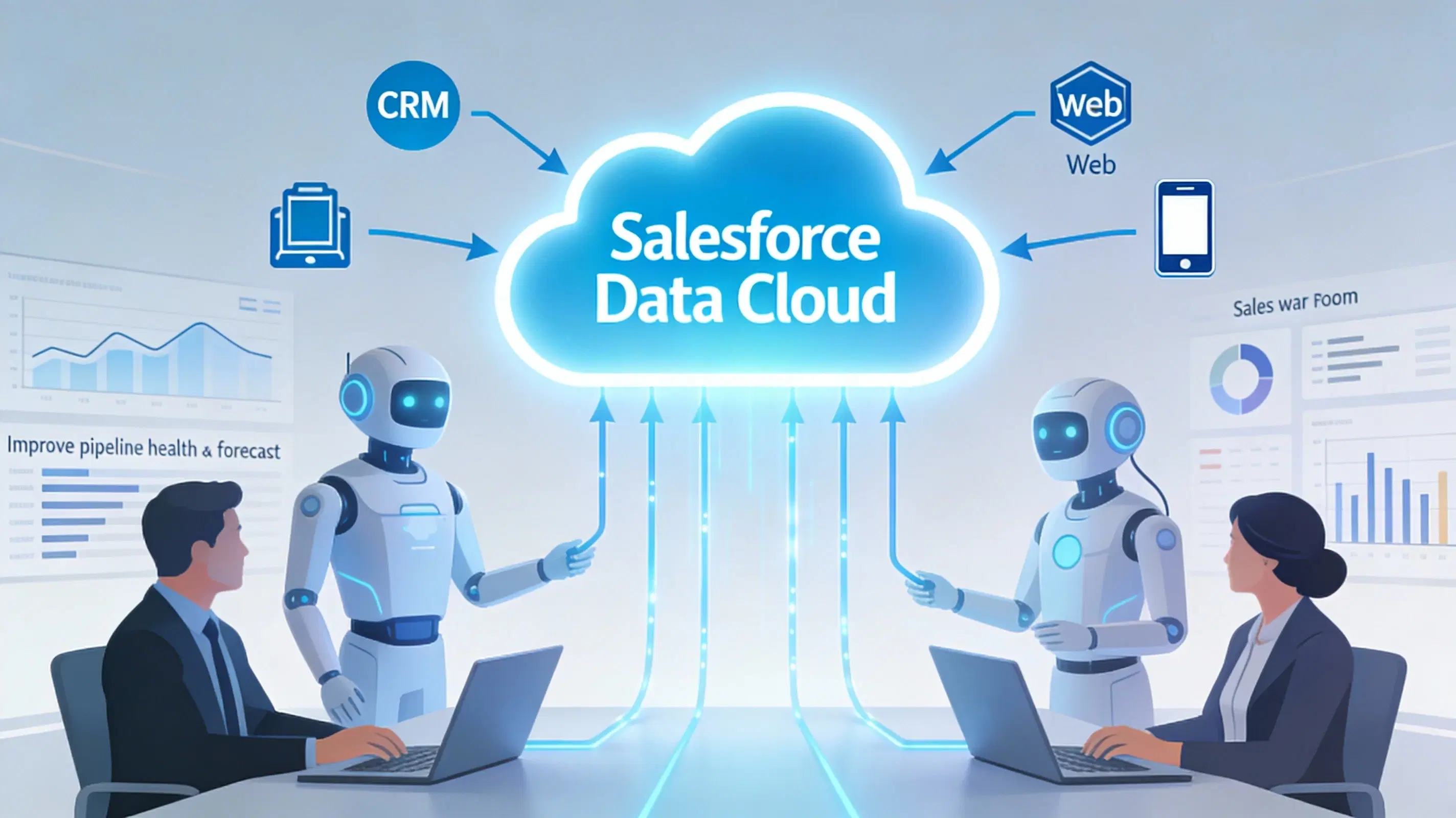
Salesforce Data Cloud solves this by creating a single, real-time customer profile that integrates CRM data, transactional records, digital engagement signals, and external sources—all with consistent identifiers and governance. This unified foundation allows AI to:
Ground responses in authoritative data instead of guessing
Trigger actions across systems with confidence
Maintain compliance and auditability across all interactions
Scale safely with enterprise-grade security and data governance
The data readiness paradox: Research shows that 84% of technical leaders recognise they need a data overhaul to support AI strategies, yet many organisations defer this work in favour of rapid AI deployment. In 2026, the organisations winning will be those that treat data modernisation as a revenue programme—not an IT cleanup project
Concrete Industry Applications
Financial Services and Banking
In financial services, Data Cloud enables 360-degree client views that combine transaction histories, investment portfolios, wealth management interactions, and even external credit and risk data. This unified profile allows AI to:
Recommend personalised financial products (mortgages, investment services, wealth management)
Flag cross-sell and upsell opportunities based on life events and spending patterns
Assess portfolio risk in real time and adjust client recommendations accordingly
Ensure regulatory compliance through consistent, auditable data lineage
Banks and insurers deploying Data Cloud alongside Agentforce report faster loan decisions, higher client satisfaction, and reduced risk exposure.
Retail and Consumer Goods
Retailers are using Data Cloud to merge in-store transactions, online browsing behaviour, mobile engagement, loyalty programme participation, and even social signals into one unified customer view. During peak seasons like Cyber Week, AI agents use this data to:
Deliver real-time, personalised product recommendations
Optimise pricing dynamically based on demand and inventory
Predict churn and trigger targeted retention offers
Analyse inventory exceptions and reorder automatically
The result: increased conversion, higher average order value, and significantly reduced marketing waste.
High-Tech and B2B
In B2B environments, unified data allows AI to:
Identify at-risk accounts before churn occurs
Score and rank opportunities by likelihood to close and deal size
Recommend personalised next steps for each opportunity stage
Generate customised executive briefings in minutes instead of hours
Sales teams report 20–30% improvements in forecast accuracy and cycle time acceleration when AI has access to complete opportunity, account, and activity data.
3. Governance and Trust: The New Executive Priority
The Governance Imperative
While enthusiasm for AI remains high, executive boards are increasingly focused on governance, explainability, and measurable outcomes. A growing number of CFOs and chief risk officers are asking difficult questions: Who can trigger this AI? What data is it allowed to access? How do we monitor quality and ensure compliance? What happens if an AI agent makes a mistake?
These are not obstacles—they are healthy signs of enterprise maturity. In 2026, organisations that can confidently answer these questions will gain competitive advantage because they will be able to deploy AI at scale without creating regulatory or reputational risk.
Salesforce's approach to trusted AI addresses this by:
Respecting permissions – AI agents enforce the same role-based access controls as humans, ensuring sensitive data stays protected
Enabling audit trails – Every decision, recommendation, and action is logged for compliance and quality review
Supporting explainability – Organisations can see why an agent recommended an action, improving trust and enabling corrections
Providing governance frameworks – Clear policies, approval workflows, and escalation paths keep AI aligned with business rules
Translating Governance into Business Value
For account teams, the governance conversation is a differentiator. Rather than positioning governance as a constraint, reframe it as a trust multiplier that unlocks larger deployments and faster adoption:
Risk mitigation – Robust governance reduces the risk of regulatory violations, brand damage, or customer trust erosion
Faster time-to-value – Clear policies allow business teams to deploy AI confidently without endless IT reviews
Scalability – Organisations with strong governance frameworks can expand AI to new business units and use cases quickly
Board alignment – Transparent AI governance becomes a shareholder value driver, not a compliance burden
4. The 2026 Imperative: From Pilots to Production
Why Production Deployment Matters
Throughout 2025, many organisations completed successful AI pilots. In 2026, the competitive advantage shifts to those who move AI into production—embedded within revenue-critical workflows where it directly impacts cycle time, exception rates, win rates, and customer lifetime value.
The distinction matters:
Pilot mindset: "Let's test this in one region and see if it works"
Production mindset: "This AI agent is now part of our primary sales process; we measure it like any business critical system"
Deloitte research warns that many organisations struggle to transition from pilots to production because legacy system integration gaps prevent AI from accessing real-time data and triggering actions reliably. Once that barrier is addressed—through modernisation of APIs, data integration, and workflows—organisations typically see measurable ROI within 3–6 months.
Success Metrics for 2026
When deploying AI in 2026, focus on business outcomes that matter to revenue leaders:
Metric | Why It Matters |
Sales cycle time | Reduced by 15–25% when reps have AI-assisted opportunity analysis |
Forecast accuracy | Improved by 20–30% when AI has complete, unified customer data |
Win rate on key plays | Lifted by 10–20% through AI-recommended strategies and personalisation |
Time to productivity | New reps reach full productivity 30% faster with AI coaching and guidance |
Customer churn rate | Reduced through predictive risk scoring and proactive intervention |
Cost per interaction | Lowered in service by 40–50% through AI-powered case deflection |
5. Actionable Steps for 2026 Go-To-Market Success
Step 1: Define Your AI Outcome
Begin with a single, measurable business outcome that matters to your organisation:
"Improve win rate on our enterprise segment by 15% in the first half of 2026"
"Reduce average handle time in support by 25% and improve CSAT"
"Identify and save 20% of at-risk renewal revenue through predictive intervention"
Avoid broad aspirations like "Implement AI across the organisation". Instead, target one workflow, one team, or one segment where success is visible and can be measured in weeks, not years.
Step 2: Assess and Unify Your Data
Audit your current data landscape:
Where does critical customer information live? (CRM, ERP, marketing automation, payment systems, external data sources)
Is it clean, consistently identified, and accessible in real time?
Where are the gaps—information living in spreadsheets, email threads, or siloed systems?
Plan a phased data unification effort using Salesforce Data Cloud. Start with the core data needed for your chosen outcome, then expand as success proves value.
Step 3: Pilot, Measure, and Scale
Deploy a focused AI capability within the team or region supporting your chosen outcome:
Use Salesforce Agentforce or Einstein AI features aligned to your workflow (e.g., call summarisation for sales, case triage for service, lead scoring for marketing)
Measure rigorously: track cycle time, exception rates, quality metrics, and user adoption
After 4–8 weeks, review results and decide whether to expand to other teams or geographies
This approach de-risks the deployment and creates internal advocates who can champion broader adoption.
Step 4: Build Governance and Compliance Into Day One
Establish clear policies on:
Who can request or configure AI agents?
What data can agents access and what is off-limits?
How will quality and accuracy be monitored?
What escalation paths exist for exceptions or errors?
This governance framework becomes a template for scaling AI across your organisation without regulatory or reputational risk.
Step 5: Invest in Skills and Change Management
AI success depends on how well your teams adopt and collaborate with these new tools:
Train reps, service agents, and ops leaders on how to work effectively with AI
Create feedback mechanisms so teams can flag issues and help refine agent behaviour
Celebrate early wins and share learnings across the organisation
Conclusion: 2026 is the Year of AI and Data as Core Revenue Levers
As Salesforce's Chief Scientist noted, the trinity of Data Cloud, Salesforce Customer 360 apps, and AI on a unified, open platform is the key to unlocking business value from enterprise data. In 2026, organisations that move decisively—combining unified data, trusted AI, and clear governance—will pull ahead of competitors who remain stuck in pilots and spreadsheets.
For revenue leaders and account teams, the path forward is clear:
Start with a measurable outcome, not technology for its own sake
Unify your customer data as the intelligence foundation for AI
Deploy focused, production-grade AI in one critical workflow
Build governance and trust into your deployment from day one
Scale what works, with clear metrics and executive alignment
The organisations that do this will not just improve sales productivity or service efficiency—they will fundamentally reshape their competitive position in 2026 and beyond.